
Guide
Coin silver vs sterling: how to read American silver marks
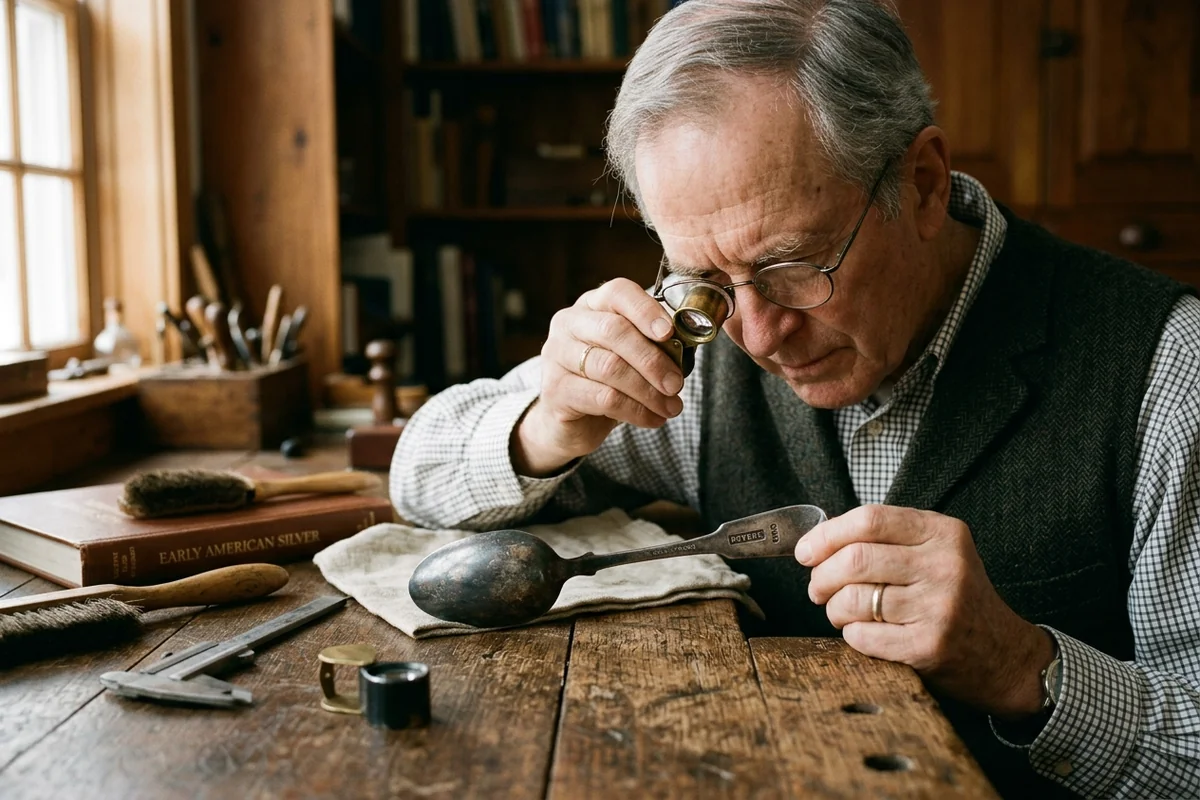
American coin silver is 90% pure silver (900/1000), crafted before 1870 by melting currency, whereas sterling silver is 92.5% pure (925/1000). Unlike Britain’s mandatory assay hallmarks, early American silver bears only a maker’s touchmark, town name, or pseudo-hallmarks. The words “Coin”, “Pure Coin”, or “Standard” indicate pre-1870 manufacture, while “Sterling” or “925” became standard after Tiffany and Gorham adopted the alloy in the 1850s and 1860s.
America had no national assay offices
The first rule of American silver is that Britain’s statutory rules do not apply. In Britain, every piece of silver submitted for sale since the fourteenth century had to pass an independent assay office test, receiving a mandatory standard mark, town symbol, and date letter. How to read British silver hallmarks explains how those legal punches allow you to date English silver to the exact year.
The United States never instituted a national assay office or compulsory hallmarking system. American silversmiths operated in an open market: they punched their own personal marks (touchmarks) into the metal, and buyers relied on the maker’s personal reputation for purity rather than a government guarantee.
What is coin silver? (c. 1750–1870)
Before the discovery of Nevada’s Comstock Lode in 1859, North America had virtually no domestic silver mines. To manufacture flatware, beakers, and teapots, early American silversmiths melted down circulating silver coins — predominantly Spanish milled dollars (eight reales) and early US silver coinage.
This alloy is known as coin silver:
- Fineness: Ranging from approximately 892/1000 (the early US mint standard) to 900/1000 (90% pure silver, balanced with 10% copper alloy for hardening).
- Physical characteristics: Coin silver feels warm, resonant, and remarkably light in the hand compared to modern weighted silver. Early pieces feature hand-planished hammer marks, cast shell or drop heels on spoon bowls, and delicate hand-engraved monograms.
- Typical marks: Eighteenth-century pieces carry only the silversmith’s initials or surname in a shaped reserve (such as P. REVERE for Paul Revere, or M. MYERS for Myer Myers). After 1830, makers increasingly added explicit quality stamps: COIN, PURE COIN, DOLLAR, STANDARD, PREMIUM, or simply C.
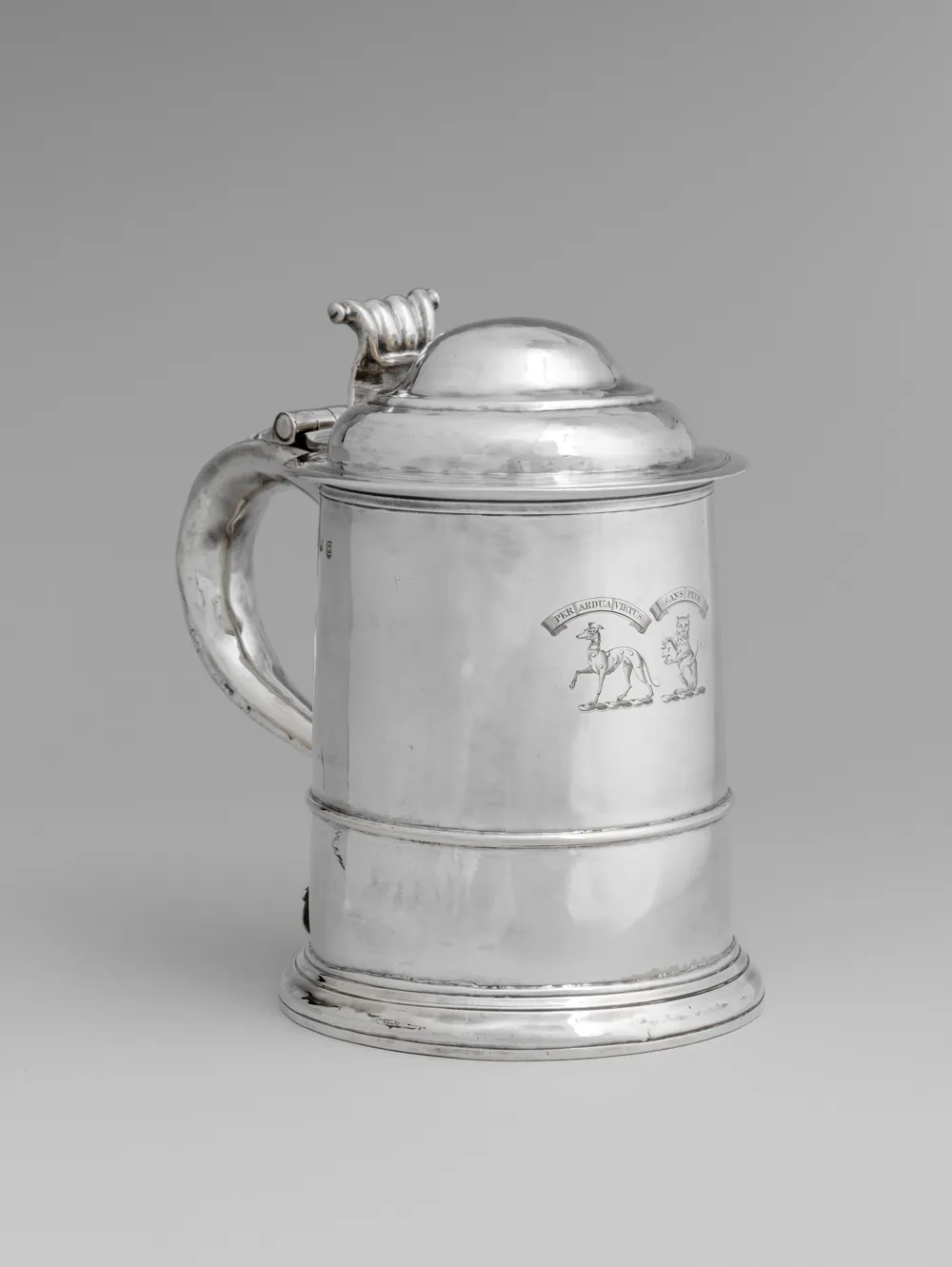
Pseudo-hallmarks: borrowing British prestige
Between 1790 and 1860, many American makers in Boston, New York, Philadelphia, and Baltimore struck small decorative punches alongside their name: an eagle displayed in an oval, a five-pointed star, a mock lion, an anchor, or an arbitrary capital letter.
These are known as pseudo-hallmarks. They were not government assay stamps and their letters do not indicate a date cycle. Silversmiths designed these punches to emulate the look of imported English London silver, reassuring Victorian buyers who associated four neat punched reserves with premier craftsmanship.
The shift to Sterling (.925) and the 1906 Stamping Act
As American commerce expanded globally, American makers transitioned to the international sterling standard (925 parts pure silver per thousand):
- Tiffany & Co. led the transition in 1851, declaring that all silverware produced under their name would meet English sterling purity (.925). Tiffany flatware from this period bears directorship letters (such as “m” for Edward C. Moore, 1873–1891).
- The Gorham Manufacturing Company adopted sterling in 1868. Gorham instituted an ingenious dating code: a lion passant, anchor, and capital “G” cartouche, accompanied by a yearly pictorial symbol (an acorn for 1868, a crescent moon for 1878, a sailboat for 1888) enabling precise dating up to 1933.
- The National Stamping Act of 1906: This federal statute prohibited marking any article “Sterling” or “Sterling Silver” unless it contained at least 925/1000 pure silver, ending decades of unregulated mark variations.
Coin silver vs. silverplate: the common trap
The single most frequent mistake made when sorting inherited silverware is confusing base-metal silverplate with solid coin silver:
- “1847 Rogers Bros”. One of the most widespread marks in American households. The “1847” is a patent reference, not the date of manufacture. The vast majority of 1847 Rogers Bros wares are electroplated silver over nickel or brass, carrying negligible precious metal value.
- Descriptive plating words. Marks stating EPNS (Electro-Plated Nickel Silver), Triple Plate, Quadruple Plate, Silver on Copper, or Sheffield Reproduction are always plated. Solid silver will never state “plate”.
- Edge and heel wear. Hold the spoon bowl or fork heel under raking bench light. On silverplated wares, heavy friction wears through the paper-thin micro-layer of silver, exposing yellowish brass or greenish nickel beneath. Solid coin silver wears to a soft, uniform gunmetal grey without peeling or colour change.
Valuing American silver: scrap vs. collector premium
Standard mid-nineteenth-century coin silver spoons (fiddle pattern spoons by common makers produced in the 1850s) trade closely around their melt bullion value. However, several categories command substantial antique premiums:
- Eighteenth-century colonial silver. Porringers, cann beakers, and salvers by pre-Revolutionary New England silversmiths regularly realize five- and six-figure auction results.
- Southern coin silver. Wares crafted by antebellum silversmiths in Charleston, Savannah, Natchez, New Orleans, and Louisville are avidly collected due to their rarity and local historical associations.
- Aesthetic movement sterling. Japanese-style mixed-metal or repoussé masterpieces from Tiffany, Gorham, or Dominick & Haff (1870–1895) command prices driven by museum-grade decorative artistry rather than weight.
Before selling any unmarked or touchmarked family silver for scrap weight, review what actually moves the value of an antique and test the piece non-destructively.
Common questions
How can you tell if unmarked old American silverware is coin silver?
Examine the construction, flexibility, and warmth. Early American coin silver spoons have thin, hammered bowls, slight irregularities from hand-raising, and often carry monograms engraved in period script. Because early silversmiths did not always stamp their work, unhallmarked pieces require professional acid, specific gravity, or XRF testing to verify 90% purity.
Does 1847 Rogers Bros mean silver was made in 1847?
No. The mark “1847 Rogers Bros” refers to the year the Rogers brothers perfected their electroplating process in Connecticut, not the manufacturing date of the piece. Millions of silverplated forks, knives, and hollowware items carrying this stamp were produced well into the mid-twentieth century and contain negligible silver value.
Is antique coin silver worth more than sterling silver?
In raw bullion value, sterling is slightly more valuable because it contains 92.5% silver compared to coin silver’s 90%. However, as historical antiques, early American coin silver items — particularly pre-1830 pieces, Southern maker touchmarks, or hollowware by renowned silversmiths — command substantial collector premiums far above their melt value.
Trove identifies antiques from photographs and gives an estimated value range, with the reasoning behind it. Every figure is an AI estimate, not a professional appraisal.
Last updated: · Research and corrections policy