
Guide
How to read a British silver hallmark
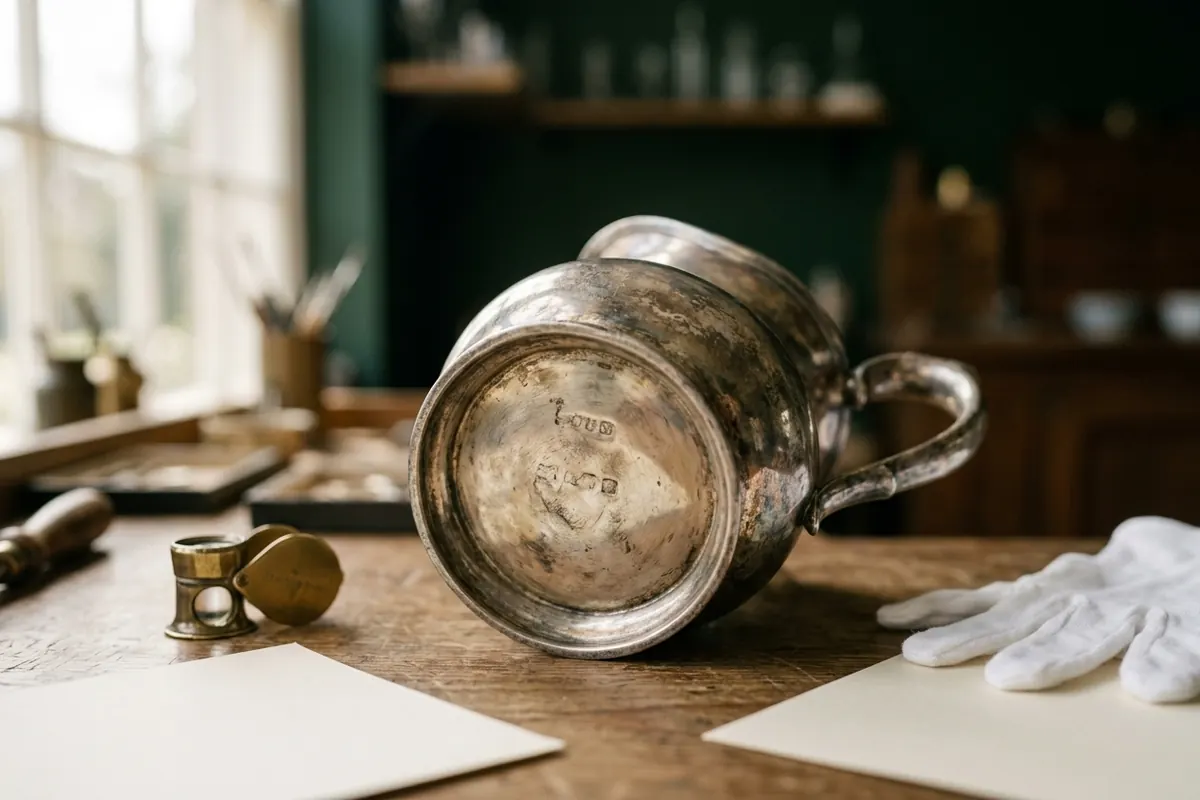
A British hallmark is a row of separate punches, each making its own legal statement. A lion passant means sterling silver. A town symbol names the assay office that tested it. A date letter gives the year, and its font and shield shape say which cycle. A monarch’s head, where present, means duty was paid between 1784 and 1890.
A hallmark is not a maker’s mark
This is the distinction everything else rests on. A hallmark is struck by an independent assay office after testing the metal — it is a legal guarantee of purity, and Britain has been striking them since the fourteenth century. A maker’s or sponsor’s mark is the initials of whoever submitted the piece. They sit in the same row and are often mistaken for each other.
The consequence is worth stating plainly: a hallmark on British silver is documentary evidence, not stylistic opinion. It is why a marked piece can be dated to the year while an unmarked one of the same form can only be placed to a generation.
The four punches, and what each one says
1. The standard mark — what the metal is
- Lion passant (a lion walking, facing left): sterling, 92.5% silver. England.
- Thistle (Edinburgh) or lion rampant (Glasgow): the Scottish sterling equivalents.
- Britannia (a seated figure) with a lion’s head erased: the higher 95.84% standard. Compulsory 1697–1720 and optional since, so it appears on early pieces and on later deliberate revivals.
- Crowned harp: Ireland.
No standard mark at all usually means it is not silver. See the section on plate below.
2. The assay office — where it was tested
A town symbol, and it narrows both place and possible dates because offices opened and closed:
- Leopard’s head — London.
- Anchor — Birmingham, from 1773.
- Crown — Sheffield, from 1773; changed to a rose in 1975.
- Castle — Edinburgh.
- Three wheat sheaves and a sword — Chester, closed 1962.
- Anchor with a cross or a tree, fish and bell — Exeter and Glasgow respectively, both long closed.
A closed office is a hard upper bound on the date, which is often the fastest thing you can establish.
3. The date letter — the year itself
A single letter, changed annually, running through an alphabet before starting again in a new typeface and a new shield shape. That is the part people miss: the letter alone is ambiguous and the letter plus its font and shield is not. A Gothic capital B in a shaped shield and a plain roman B in a plain shield are different cycles, decades apart.
Each office ran its own cycle, so you must identify the office first and then read the letter against that office’s table. Do not try to memorise them — photograph the mark clearly and check it against a published table for that office.
4. The duty mark — a dating shortcut
A monarch’s head in profile means duty was paid on the piece. It was struck from 1784 to 1890, so its presence brackets the date to roughly a century immediately, and its absence on a piece that otherwise looks Georgian is a question worth asking.
What is not a hallmark
Electroplated pieces carry marks that are designed to look reassuring and mean something quite different:
- EPNS — electroplated nickel silver. Contains no silver beyond the plating.
- EPBM — electroplated Britannia metal. Same, on a softer base.
- A1, “Sheffield Plate” on a modern piece, or a string of pseudo-marks arranged to resemble a hallmark row: all makers’ trade marks, none of them assay marks.
- 925 alone — a numeric purity mark, common on imported and modern silver. It says the metal is sterling; it says nothing about where or when.
The tell is that real British hallmarks are separate punches struck individually, often at slightly different depths and angles. A row cast or stamped as one unit, perfectly aligned, is a trade mark imitating a hallmark.
Photographing the mark
Hallmarks are small, shallow and struck into a reflective surface, which is the worst combination for a phone camera. Use raking light — a lamp low and to one side — so each punch casts a small shadow, and fill the frame with the row rather than photographing the whole base. The photography guide covers the rest.
If the marks are worn to the point of illegibility, that is an answer too: an unreadable hallmark cannot be read confidently by anyone, and a confident attribution from one should be treated with suspicion.
Common questions
How do I date silver from its hallmark?
Identify the assay office from the town symbol first, then read the date letter against that office’s own cycle table, matching the typeface and the shield shape as well as the letter itself. The letter alone is ambiguous; the letter with its font and shield is not.
Does EPNS mean my piece is silver?
No. EPNS is electroplated nickel silver — a thin layer of silver over a base metal, with no silver content beyond the plating. It is a maker’s trade mark, not an assay mark, and pieces carrying it are worth a small fraction of solid silver.
What does the lion mark on silver mean?
A lion passant — walking, facing left — is the English mark for sterling standard, 92.5% silver. A lion rampant, rearing up, is the Glasgow equivalent; a thistle is Edinburgh’s. A lion’s head erased alongside a seated Britannia indicates the higher 95.84% Britannia standard instead.
Trove identifies antiques from photographs and gives an estimated value range, with the reasoning behind it. Every figure is an AI estimate, not a professional appraisal.
Last updated: · Research and corrections policy