
Guide
How to read an antique porcelain backstamp
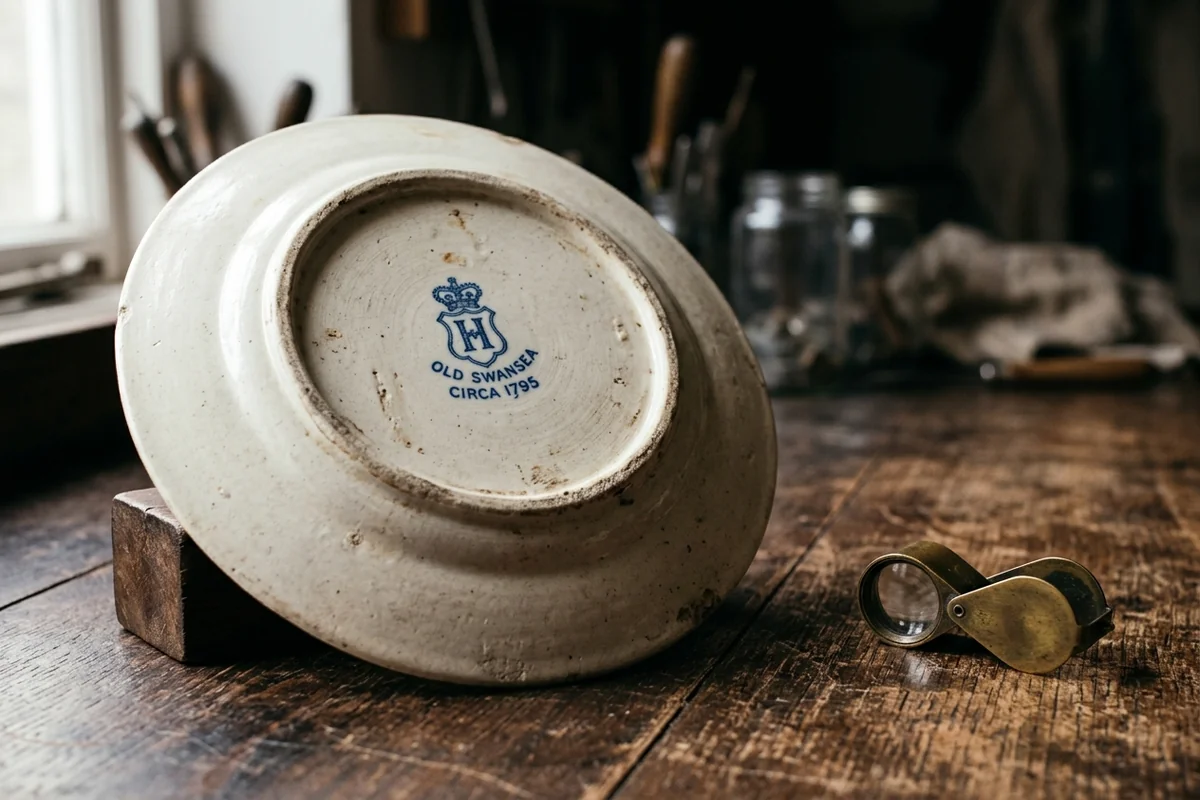
To read an antique porcelain backstamp, examine the mark under raking light and note whether it is underglaze, overglaze, or impressed into the paste. Identify the factory symbol or initials, look for date cyphers or tally dots, and read the country wording: plain country names date from 1891, while “Made in” indicates manufacture after 1921. Compare the mark with the ceramic body, foot rim, and glaze before assigning a date.
The underside tells you what the face cannot
When assessing fine porcelain, the decorated face displays artistic taste, but the underside carries the documentary record. Potteries identified their work through stamped emblems, painted monograms, incised mould numerals, decorator tallies, and regulatory country inscriptions.
A mark is evidence of intent, not an automatic certificate of authenticity. Because porcelain marks have been forged, copied, and misattributed since the eighteenth century, every backstamp must be read as part of a three-way agreement between the mark, the ceramic body, and the pattern itself. If you are examining British earthenwares alongside porcelain, consult how to read Staffordshire pottery marks.
Four ways porcelain marks were applied
How a mark sits on the ceramic reveals its stage in production and limits when it could have been applied:
- Underglaze marks. Painted or stamped onto bisque ware before dipping in liquid glaze and firing at high temperatures (typically in cobalt blue, chrome green, or pink). The mark sits sealed beneath a glassy layer, impossible to alter or remove without grinding down the glaze.
- Overglaze marks. Printed or hand-enamelled on top of the already fired glaze and fixed in a low-temperature muffle kiln (often in iron red, black, puce, or liquid bright gold). These marks feel slightly raised to the touch, can show surface rubbing, and were occasionally added years after the blank was potted.
- Impressed and incised marks. Stamped with a metal die or cut by hand into the damp clay body before firing. These include size codes, shape numbers, batch symbols, and year letters. They cannot be faked after firing.
- Tally and gilder marks. Small painted numerals, dots, or initials near the foot rim. These identified the piece-work painter or gilder for factory payment rather than dating the piece.
Reading country names and import laws
International customs statutes provide precise date thresholds that separate antique porcelain from twentieth-century vintage production:
- No country name (pre-1891). Eighteenth- and nineteenth-century pieces made for domestic European sale or export before 1891 rarely stated a country. They carried only factory marks, initials, or were left completely unmarked.
- Country name alone (1891–1921). The United States Tariff Act of 1890 (the McKinley Tariff) mandated that all foreign goods imported into America state their country of origin. Marks featuring simply ENGLAND, GERMANY, FRANCE, BAVARIA, or NIPPON were introduced in or shortly after 1891.
- “Made in [Country]” (post-1921). Following revisions to the US customs laws in 1921 and the British Merchandise Marks regulations, wares imported into the US and Commonwealth required the prefix phrase: MADE IN ENGLAND, MADE IN GERMANY, or MADE IN JAPAN. Any piece bearing “Made in” is strictly twentieth century.
- Occupational and regional zones. Marks reading Made in Occupied Japan date strictly to 1945–1952. Marks noting Made in Western Germany or German Democratic Republic (GDR) date between 1949 and 1990.
- “Bone China”. The words “Bone China” or “English Bone China” printed in modern sans-serif or script typefaces became standard in backstamps only after the early twentieth century.
Factory cyphers and date codes
Several premier European potteries used proprietary dating codes that pinpoint production to a single calendar year:
Royal Worcester
From 1891 to 1915, Royal Worcester added tiny dots around the standard crowned circle mark: one dot for 1892, two for 1893, up to twenty-four dots in 1915. From 1916 through the 1930s, the company substituted asterisks, open circles, and letter cyphers beneath the mark.
Meissen and cancellation cuts
The iconic crossed swords of Meissen were adopted in 1722. Subtle stylistic shifts — such as pommels touching, curved hilts, an asterisk between the blades (the Marcolini period, 1774–1814), or a dot between the hilts (the Academic period, 1763–1774) — bracket centuries of manufacture.
Critically, examine the crossed swords for grinding cuts across the mark. One to four wheel-cut incisions scored through the blue swords indicate a factory second sold undecorated to outside decorators (Hausmaler) or dismissed for firing flaws.
Minton
Minton impressed an annual year cypher into the soft paste alongside its printed mark from 1842 until 1942. These miniature geometric glyphs — triangles, stars, half-moons, anchors — match specific years in published reference tables.
Cross-referencing mark with ceramic body
- Hard-paste vs. soft-paste vs. bone china. True hard-paste porcelain (Meissen, early Chinese, Vienna) is vitreous, cold to the cheek, and displays a white, shell-like fracture if chipped. Soft-paste (early Sèvres, Bow, Chelsea) is warmer, chalkier, and easily marked. Bone china (Staffordshire, Spode) is intensely white, strong, and highly translucent under a flashlight.
- Inspect the foot rim. Authentic period plates were fired on unglazed foot rims or stilt pads. Look for three tiny unglazed spur marks on early English and French porcelain, or a smooth, slightly discoloured biscuit foot on German hard paste.
- Beware spurious and reproduction marks. The French firm Edmé Samson of Paris specialized in nineteenth-century copies of Chelsea, Worcester, Derby, and Meissen, stamping an “S” or subtle variation that was frequently ground off by unscrupulous dealers later. Refer to how to tell a reproduction from a period piece for guidance on identifying later copies.
Common questions
What does a scratch or cut through a porcelain mark indicate?
A scratch, score line, or grind cut across a porcelain backstamp indicates that the piece was sold as a second or factory reject. Major European potteries like Meissen and Royal Copenhagen marked items with firing cracks, glaze defects, or decoration flaws with one to four cuts through the mark to protect their first-quality reputation.
What is the difference between an underglaze and overglaze porcelain mark?
An underglaze mark was painted or stamped onto unglazed ceramic before the glaze firing, sealing it permanently beneath a smooth, glassy protective layer. An overglaze mark was applied on top of the fired glaze and refired at a lower temperature, leaving a slightly raised texture that can wear away or be added later.
What does Made in England or Made in Germany tell you about porcelain age?
Wording indicates customs compliance dates. Under the 1891 US McKinley Tariff Act, imported porcelain had to display the country of origin, so marks showing solely England, Germany, or France date after 1891. The phrase “Made in” became standard practice following the 1914 British Merchandise Marks revisions and 1921 US regulations, placing those pieces after 1921.
Trove identifies antiques from photographs and gives an estimated value range, with the reasoning behind it. Every figure is an AI estimate, not a professional appraisal.
Last updated: · Research and corrections policy